Most workout apps keep your data on their servers, push you towards a subscription, or vanish
when the company does. openGym runs on your own box, keeps your data in a folder you control, and
is yours to fork. It still behaves like a modern app: installable on the home screen, passkey
sign-in, works offline, syncs between your phone and your laptop.
No account on someone else's server, no subscription, no ads, no telemetry. One
docker compose up and it's running.
The in-browser demo is the real app with example data,
if you want to try it before installing anything.
Features
Planning
A routine per weekday over a library of over 5,600 exercises with animated demos, searchable and
browsable by muscle on a body map. Filter by the equipment you own.
Four starter plans (Push/Pull/Legs, Upper/Lower, Full Body, 5×5) that load as ordinary,
editable routines.
Move a session to another day without touching the weekly plan. The week starts on Monday or
Sunday, your choice.
Or skip the weekdays altogether: a rotation (A, B, C, A, ...) where the next session is
simply the next one you haven't done, however the week went.
Supersets, warm-up sets, drop sets and rest-pause, timed exercises (planks, hangs, carries),
cardio by time and speed, rest time per exercise, planned deloads.
Your own exercises, with your own photo, GIF or short video. Location data is stripped on the
device before upload.
Training
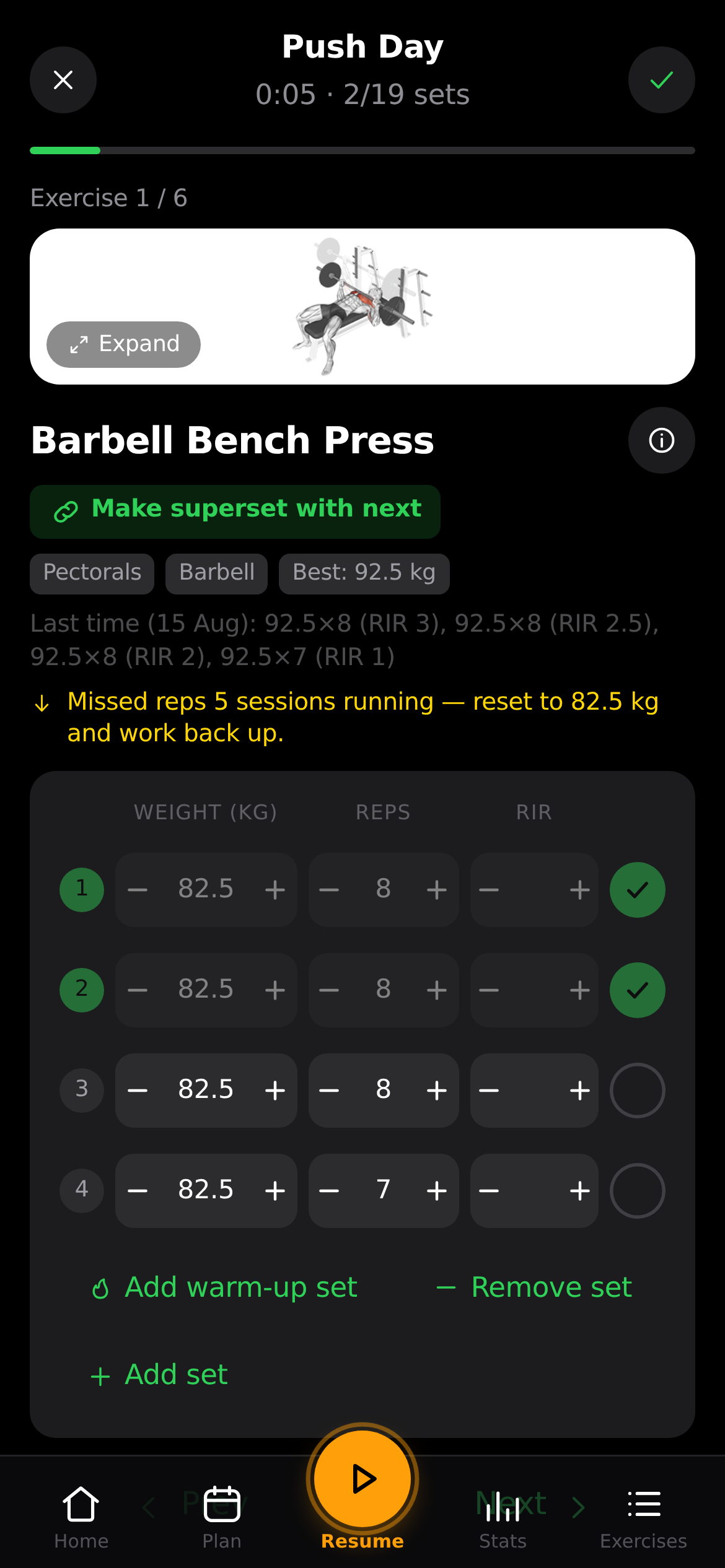
Guided sessions: today's workout starts itself, weights are pre-filled from last time, a rest
timer runs between sets, PRs are detected as you go. On a rest day it tells you when the next
session is.
A quiet workout screen: one menu per exercise, the set number as the set's own menu, card or
list view. Switches in Settings bring the old button rows back if you liked them.
Optional effort column as RIR or RPE, colour-coded, with a plain-language line per level.
Plate math for barbell, EZ bar, trap bar and Smith machine, worked out from the plates you own.
Bodyweight exercises know they carry no load: log reps, add a dip belt if you use one.
Per-side reps for lunges and single-arm work, the screen stays awake while you train, and a
rest-timer alert can flash the screen for loud gyms.
Swipe a set left to delete it (with Undo) or right to copy it. Pyramid sets with their own reps
and rest per set, and a scroll wheel for any rest time up to 15 minutes.
Progress
Progression rules per routine or per exercise: linear, Greyskull LP, double progression through a
visible rep range, triple progression (reps, then sets, then load), or adding time. Each target explains why it is that number; missed reps never
add load, stalls trigger a deload.
Estimated 1RM per exercise with its own curve, Structural Balance ratios (Poliquin, Thibaudeau,
ATG), a year-long activity heatmap.
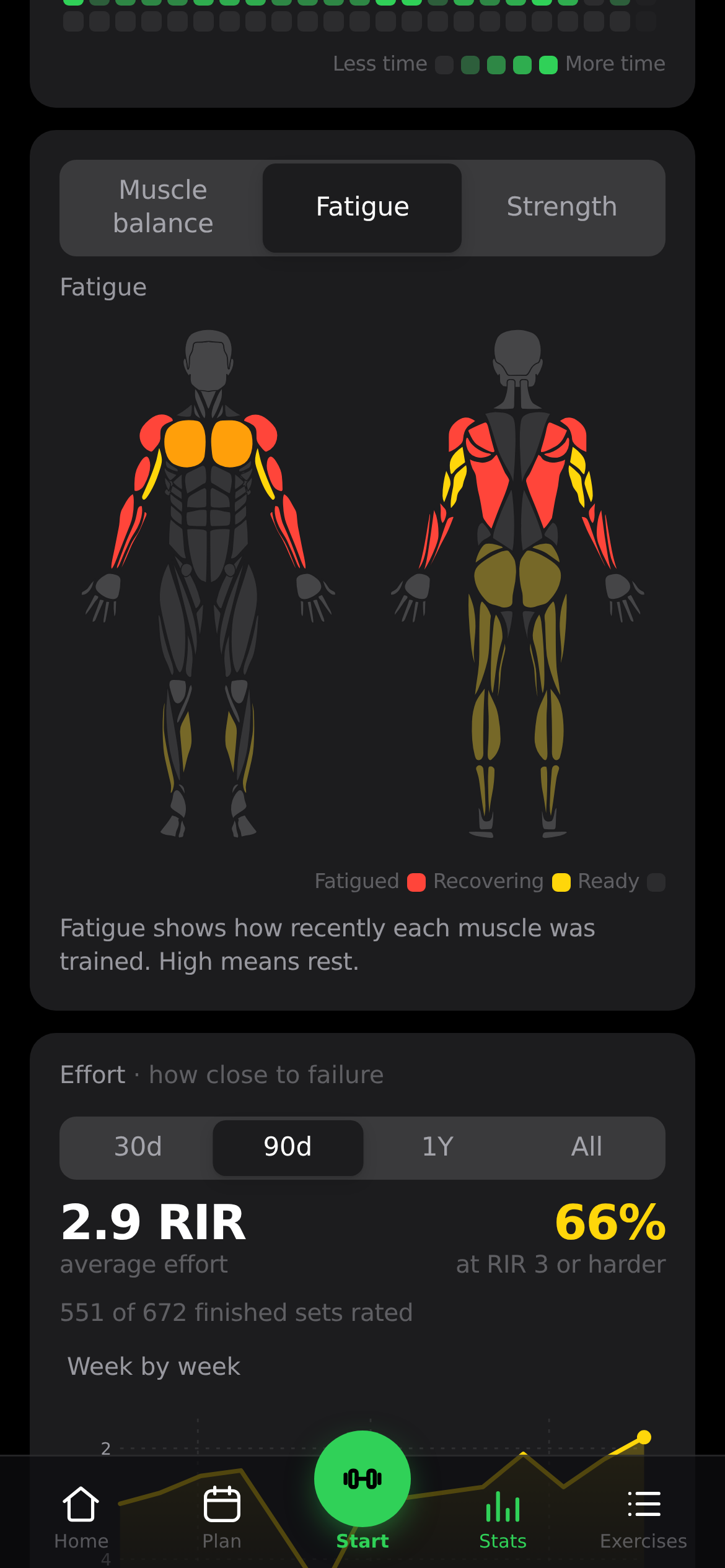
A muscle map in three modes: where your volume went, what is still recovering, and what has gone
untrained.
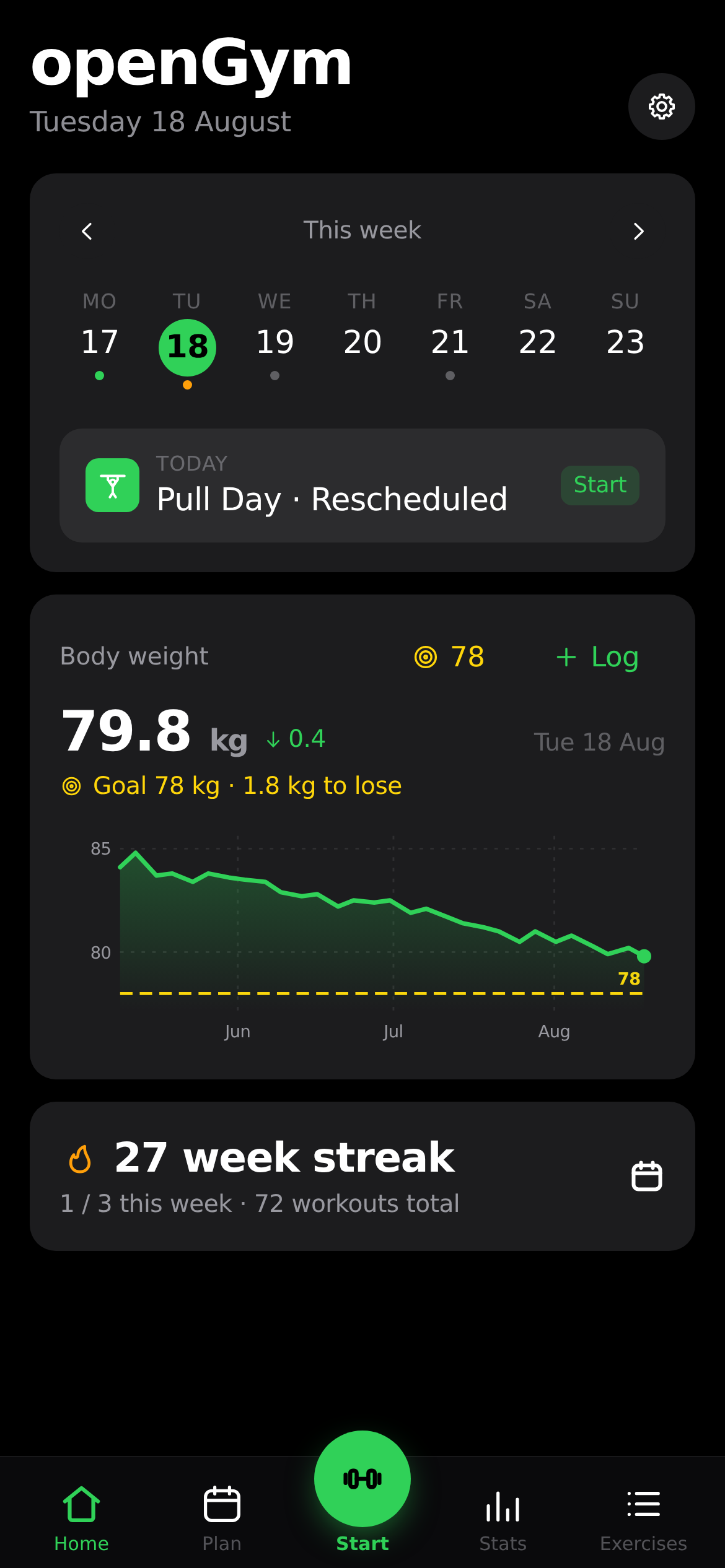
Body-weight chart against a goal line, and progress photos on a timeline with a before/after
slider.
Edit any saved workout after the fact, log one you did on paper, or move it to the right date.
Records are re-read from the corrected history.
Accounts and data
Passkeys (Face ID, Touch ID, fingerprint) with per-profile data synced across devices. Password
sign-in can be switched on per instance; new devices pair with a one-time code or QR.
Two devices editing at once merge field by field instead of overwriting each other (see
sync).
Import from FitNotes, Strong, Hevy (CSV or API key) and Apple Health weight exports. Export
everything as one JSON file whenever you like.
Share a plan as a small file or print it as a PDF.
Optional admin dashboard with invite-only signup and an activity log.
19 languages, including right-to-left Arabic and Traditional Chinese. Exercise names and
instructions are translated for most of them.
Optional extras, off by default
An AI coach that drafts a week of routines and later suggests changes based on
what you logged. You approve every change. It runs on your server with your own provider key
(Anthropic, OpenAI, Gemini or any OpenAI-compatible endpoint, Ollama included).
An MCP server so an assistant like Claude Desktop can answer questions about your
training history. Read-only and local; not part of the Docker build.
The full list of what changed release by release is in the changelog.
git clone https://github.com/DuarteSantos8/openGym
cd openGym
cp .env.example .env
docker compose pull      # prebuilt images, amd64 + arm64 (skip this to build from source)
docker compose up -d
Open http://localhost:8080, tap Create profile, and you're in. The exercise animations are
part of the image, so there's nothing else to download.
To reach it from your phone with passkeys you need HTTPS on a domain; that's a two-line change in
.env. The self-hosting guide walks through Cloudflare Tunnel, Caddy,
Traefik and nginx, and there are separate guides for
HTTPS on a LAN and Kubernetes.
[!NOTE]
Images are published from the same tag to ghcr.io/duartesantos8/opengym-{api,web}
(what docker-compose.yml pulls) and registry.gitlab.com/duartesantos8/opengym/{api,web}. Swap
the image: lines if you prefer GitLab's registry, or run docker compose up -d --build to build
locally. Either way you don't need Node on the host.
Configuration reference (all through .env)
Variable
What it does
Default
RP_ID
Hostname passkeys are bound to
localhost
ORIGIN
Full URL the app is served from
http://localhost:8080
WEB_PORT
Host port for the web UI
8080
NGINX_PORT
Port the web container listens on inside the container
80
BACKEND
Name of the API service that /api is proxied to
api
PORT
Port the API listens on; the web container proxies to the same value
3000
RP_NAME
Name shown in the passkey prompt
openGym
SESSION_DAYS
How long a sign-in lasts, in days
90
ADMIN_UIDS
User ids that get the admin dashboard, comma-separated
(none)
FIRST_USER_ADMIN
1: the first profile created on an empty instance becomes its admin
(off)
INVITE_ONLY
Require an invite code to create a profile
(off)
ALLOW_GUEST
Offer "Continue without account"; 0 requires a profile
(on)
PASSWORD_LOGIN
Offer name-and-password sign-in next to passkeys
(off)
TRUST_PROXY
Let the sign-in throttle read the client address from proxy headers
1 in docker-compose.yml
AUDIT_LOG
Record sign-ins and admin actions; 0 records nothing
(on)
AUDIT_MAX
Events kept in the activity log; 0 for no limit
5000
AUDIT_DAYS
Days kept in the activity log; 0 keeps until AUDIT_MAX
90
AUDIT_IP
Record the caller's address: off, net (network only) or full
off
ALLOWED_PRIVATE_IPS
Private addresses push endpoints may resolve to (FakeDNS, split-horizon DNS): comma-separated IPs, a-b ranges or CIDR blocks
(none)
VAPID_SUBJECT
Contact URL sent with push notifications
your ORIGIN
API_TARGET
API image to build: default, or coach with the Claude Agent SDK and Codex CLI
default
COACH_DISABLED
1 forces the AI coach off instance-wide
(unset)
Push-notification keys are generated on first run into ./data/vapid.json. DATA_DIR is pinned to
/data inside the container and mapped to ./data on the host; change the volume, not the
variable. The self-hosting guide covers every option in detail.
Phone app
The same codebase builds a standalone app with Capacitor: no account, no server, everything stays
on the phone, with native reminders and a rest countdown in the notification shade.
Android: download the signed APK from the latest release
or the website. Each build sits next to its .sha256, and
the app checks for updates itself. openGym is deliberately not on the Play Store.
iPhone: Apple doesn't allow installs outside the App Store. Self-host and add the PWA to your
home screen from Safari, or build the native app onto your own device with Xcode.
frontend/ is React 19 and Vite (React Router, Zustand), built to static files inside Docker.
api/ is plain node:http with two dependencies: @simplewebauthn/server for passkeys and
web-push for notifications. Everything is stored as JSON under ./data.
web/ builds the frontend and serves it with nginx, proxying /api so the whole app sits on
one origin, which passkeys require.
The training logic (progression rules, 1RM, how a logged session is read back) lives in pure
functions under frontend/src/lib/ with tests beside them. The HTTP API is documented as an
OpenAPI spec in api/openapi.yaml, browsable at
opengym.ch/api.html.
How sync works
Each profile's data is one document with a server revision. A device sends the revision it last
saw along with its changes; if another device wrote in between, the server refuses and returns the
current document so the device can merge and retry. Every change carries its own stamp, down to a
single setting or routine field, so the merge keeps the newest edit of each one and a deletion stays
deleted.
Nothing that hasn't reached the server is discarded on disconnect or sign-out, and the app shows a
banner whenever it's working offline.
Your data
Everything lives in ./data on your host:
File
Contents
db.json
Profiles and public passkey data
db.json.bak
A copy of the last good db.json, used if the main file can't be read
state-<user>.json
Each user's plan, workouts, body weight and settings
audit.log
Admin activity log (no IP addresses unless you turn that on)
secret
Session-cookie signing key
Back up ./data and you've backed up everything. Passkey private keys never reach the server; they
stay in your phone's secure hardware or your password manager.
Documentation
The documentation index sorts every guide by who it's for. The most used ones:
A release roughly every two weeks, each small and themed. The full plan is in
ROADMAP.md, and the issues sit in the
GitHub milestones. The next two releases
finish the community wishes, then comes a new exercise database and a themed release every
two weeks after it.
Release
When
Theme
v1.3.10
released Oct 2026
New design, rotation, swipe actions, safer sync
v1.3.11
next
Fixes, about thirty community pull requests, Health Connect, measurements
v1.3.12
Nov 2026
Community features: focus view, widget, timer rework
v1.4.0
Nov 2026
A new exercise database
v1.4.1 to v1.4.4
Dec 2026 and Jan 2027
Programmes, the progression engine, cardio
v1.4.5 to v1.4.10
Jan to Apr 2027
Search, accounts, the iOS app, Android and health, looks
later
Database storage
Community
Discord for release announcements, self-hosting help and
quick back-and-forth. Usually the fastest way to get an answer.
Discussions for questions and ideas
you want the next person to find by searching.
Issues for reproducible bugs and agreed-on
work. Login trouble is almost always an RP_ID/ORIGIN mismatch; the
self-hosting guide covers it.
GitHub is the home of the project. gitlab.com/DuarteSantos8/opengym
is a mirror, updated by a GitHub Actions workflow on every push to main and every release tag. It
exists because its CI builds the release artifacts: the signed APK, the multi-arch images and the
SBOMs. Nothing is merged there by hand. In the changelog, !NN refers to a GitLab merge request
from the weeks in August and September 2026 when the project lived there.
How openGym is built
People have asked about this, so plainly: openGym is developed with
Claude Code, Anthropic's coding agent. A large share of the
code, tests and documentation is drafted in Claude Code sessions, and the repository carries a
CLAUDE.md with the project context those sessions start from.
What that does and doesn't mean:
A person decides and ships. What goes in, what gets reviewed and merged, and every release
are the maintainer's call. Changes are tested on a staging instance and on real phones before
they are tagged.
Tests hold the logic in place. The training logic is covered by unit tests, and pull requests
run the frontend, API and MCP suites in CI. That is the guard against plausible-looking code
that is wrong, whoever or whatever wrote it.
The app itself doesn't need an LLM. Nothing in a default install calls an AI service. The AI
coach and the MCP server are opt-in, and the coach only talks to the provider you configure, with
your own key.
Community pull requests are written by their authors, with whatever tools they like, and reviewed
the same way.
Support
openGym is free and stays free: AGPL, no paid tier, nothing held back for sponsors. If it replaced a
paid tracker for you and you'd like to chip in, there's a coffee button below. A star, a bug report
or a pull request helps just as much.
License
openGym's own code is licensed under the GNU AGPL v3.0. You can self-host, use,
modify and share it; if you run a modified version as a network service, you have to offer that
version's source under the same license.
What is this?A self-hosted gym and body-weight tracker you run on your own server: plan routines, follow guided workouts, log every set and your body weight. No subscription, no ads, no telemetry; your data stays yours.
Do I use it in a browser or on my phone?Both. It's a self-hosted web app you can install to the home screen as a PWA, and the same codebase builds a standalone Android APK (deliberately not on the Play Store). On iPhone you add the PWA from Safari.
How do I get it running?Install Docker with Compose, put the repo's docker-compose.yml in place and run docker compose up; images pull from ghcr.io, so no Node is needed on the host. RPID and ORIGIN in .env bind passkeys to your domain.
Anything that trips people up during setup?Sign-in is the usual culprit: passkeys bind to your hostname, so trouble is almost always an RPID/ORIGIN mismatch, which the self-hosting guide covers.
Where does my data actually end up?In ./data on your own host, as plain JSON files you can back up by copying. There are no ads, no telemetry and no account on anyone else's server, and passkey private keys never reach the server.
Is there an AI coach, and what does it need to run?Yes, optional and off by default: it drafts a week of routines and later suggests changes you approve one by one. It runs on your server with your own provider key: Anthropic, OpenAI, Gemini, any OpenAI-compatible endpoint or Ollama.
What is the MCP server for?It lets an assistant like Claude Desktop answer questions about your training history. It is read-only, runs locally, and is not part of the Docker build.
How many languages does it support?19, including right-to-left Arabic and Traditional Chinese, with exercise names and instructions translated for most of them.
How often does openGym get updates?A small themed release roughly every two weeks; the roadmap lists Health Connect, a home-screen widget, a new exercise database and a future native iOS app.












 A self-hosted gym and body-weight tracker you run on your own server: plan routines, follow guided workouts, log every set and your body weight. No subscription, no ads, no telemetry; your data stays yours.